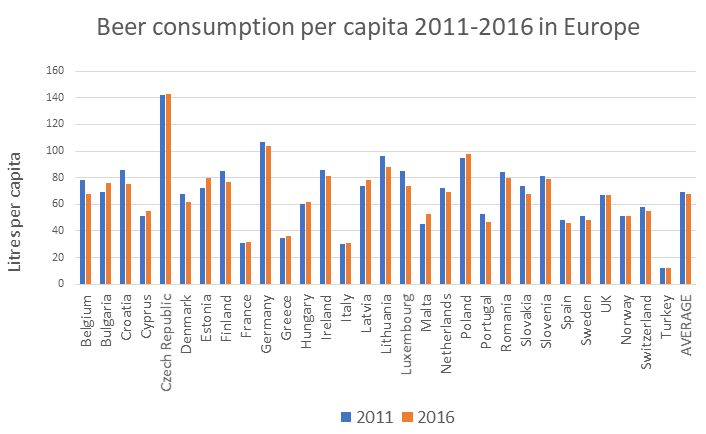
A unit, typically a bottle or a can, of beer is >330mL in volume, ~150kcal, ~5% ethanol in content with consumption varying amongst European countries, where as a whole continent Europeans consume almost 70 litres of beer per capita (image below). This equates to roughly a unit of beer every 2 days but could also be considered as 4 units in one day of the same week. Either way, beer seems to have a place and maybe not exactly within the daily lives, certainly within weekly ones. Let’s explore this a little bit.
From personal experience I must admit, having a sip of my father’s beer at the age of 12 was repelling. But over the years this has changed, and I have come to enjoy the taste of beer, especially cold beer. However, taste in general is highly variable and Joanna Fantozzi’s blog may provide some insight into why some dislike the taste of beer.
In my opinion, beer is a great balance between an enjoyable taste and a reasonable amount of alcohol, making it an excellent drink in a social setting but also for a relaxation session on a Friday night after work. Generally, a unit of beer may induce some euphoria, relaxation and reduce shyness with no loss of coordination or the depressant effects of alcohol. Additional units allow progression into significant euphoria, a feeling of warmth and well-being, albeit with some loss in coordination. These effects may be desired in both cases.
As an example, let’s say you left work with an unresolved conflict. The resolution of this conflict relies on a response from your higher-ups, but the response might take a couple days to reach you. Anxiousness experienced might induce impulsiveness in your decision-making i.e. you end up prematurely writing to your higher-ups worsening the situation for yourself. A study by Hartley and Phelps explores the relationship between anxiety and decision-making and suggest anxiety creates subconscious attractiveness towards negative decisions and tends to mask decisions which would yield positiveness. In this case, the euphoria and relaxation experienced could result in a more reactive approach rather than a proactive one i.e. waiting for the response.
Having said that, according to the American Institute of Stress – job pressure, money, health, relationships, poor nutrition, media overload and sleep deprivation are the top causes of stress amongst adults. Most experience a combination of these stressors to a varying degree throughout their lifetimes. But what happens when the stressors pile up and/or overlap? Short-term or occasionally stressing situations or periods are actually essential. These situations stimulate behavioural and/or cognitive changes allowing us to overcome certain hurdles. However, intense and/or prolonged stress due to multiple sources can threaten addiction. Coming back to the example of anxiety – that one bottle of beer might help on that particular night, but then the next night another issue arises, and I hope you can see the pattern here. A bottle of beer for relaxation might evolve into a coping mechanism.
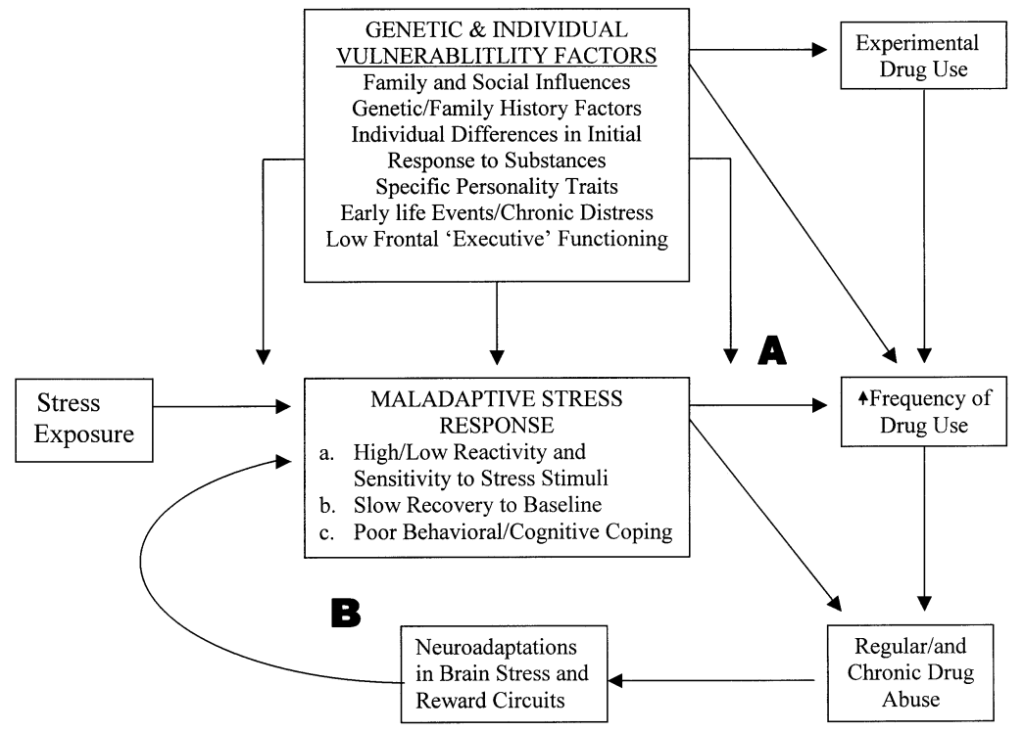
Interestingly, the alcoholic content of beer stimulates release of dopamine in the brain. Dopamine is a critical player in the human reward pathway, in other words, feelings of accomplishment also result in dopamine release. Stimulation of dopamine release in the brain is part of smoking addiction too. This relates to the review by Sinha summarising a number of research papers which postulate the intricacies of the stress-coping model of addiction (image below).
Furthermore, ~150kcal represents ~7% of the total daily calorie intake, this can sometimes be disregarded and therefore gets the name – hidden liquid calories. Consuming beer even moderately could contribute to a positive daily net calorie intake due to an imbalanced consumption of other constituents of the diet, which may or not be a result of other stressors (sometimes called stress eating), resulting in weight gain. Scott and colleagues evaluate effects of chronic social stress on weight gain and support the claim. The weight gained through beer consumption presents as a new source of stress. Ironically, enjoying beer to relax becomes a coping mechanism which then turns into a stressor, perpetuating the cycle.
Of course, a bottle of beer every 2 days or so does not endanger your health, nor will it instantly result in addiction and by roughly calculating your daily calorie intake you will not develop a beer belly, in fact, it may just prevent your next heart attack. It is however critical to understand that you should identify on a personal level whether moderate consumption of beer could develop into excessive consumption of alcohol.
Liked the Blog? Or maybe you didn’t? Try the others!
Coffee: an underlying drug?
Fizzy drinks: the pleasurable taste
Green tea: toxicity?
Water: it’s healthy, right?
 commondrinksand.water.blog